
Market Interpretation
Question 7 Explained: What Small Lot Zoning Would Mean for Belmont and Watertown
Question 7 would set a statewide floor for single-family lots. Does a lot have 5,000 square feet, 50 feet of frontage, and public sewer and water? Then a city or town would have to allow a single-family home on it. Towns would still set the rules for setbacks, height, size, and parking.
Zoning is the least understood item on the November ballot. It is also one of the most important. Most of what I found written about it talks about Massachusetts as a whole. That was no help to me, so I pulled the zoning tables for Belmont and Watertown and worked out what this would do to each one.
How you vote is your business. My job here is to put the numbers in front of you, give both sides a fair hearing, and spell out what each outcome would actually mean on your street.
What would Question 7 actually change?
Right now, every city and town sets its own minimum lot size. That is the smallest piece of land a house may sit on. The rules vary a lot, and in much of the state they are large.
Question 7 would add one paragraph to the state Zoning Act. In any district that allows homes, a town could not block a single-family home or require a special permit for one. The lot would have to meet three tests:
- At least 5,000 square feet of land, roughly one-eighth of an acre
- At least 50 feet of frontage on a street or public way
- Access to public sewer and public water
Towns would keep the rest. How tall a building can be. How much of a lot it can cover. Setbacks, parking, and short-term rental rules. All of it stays local. The state housing office could issue guidance on how the law works in practice.
One thing to be clear about: this measure does not build anything. It changes what is allowed. Whether homes follow depends on who owns the land, what they choose to do, and whether the math works.
What would it change in Belmont?
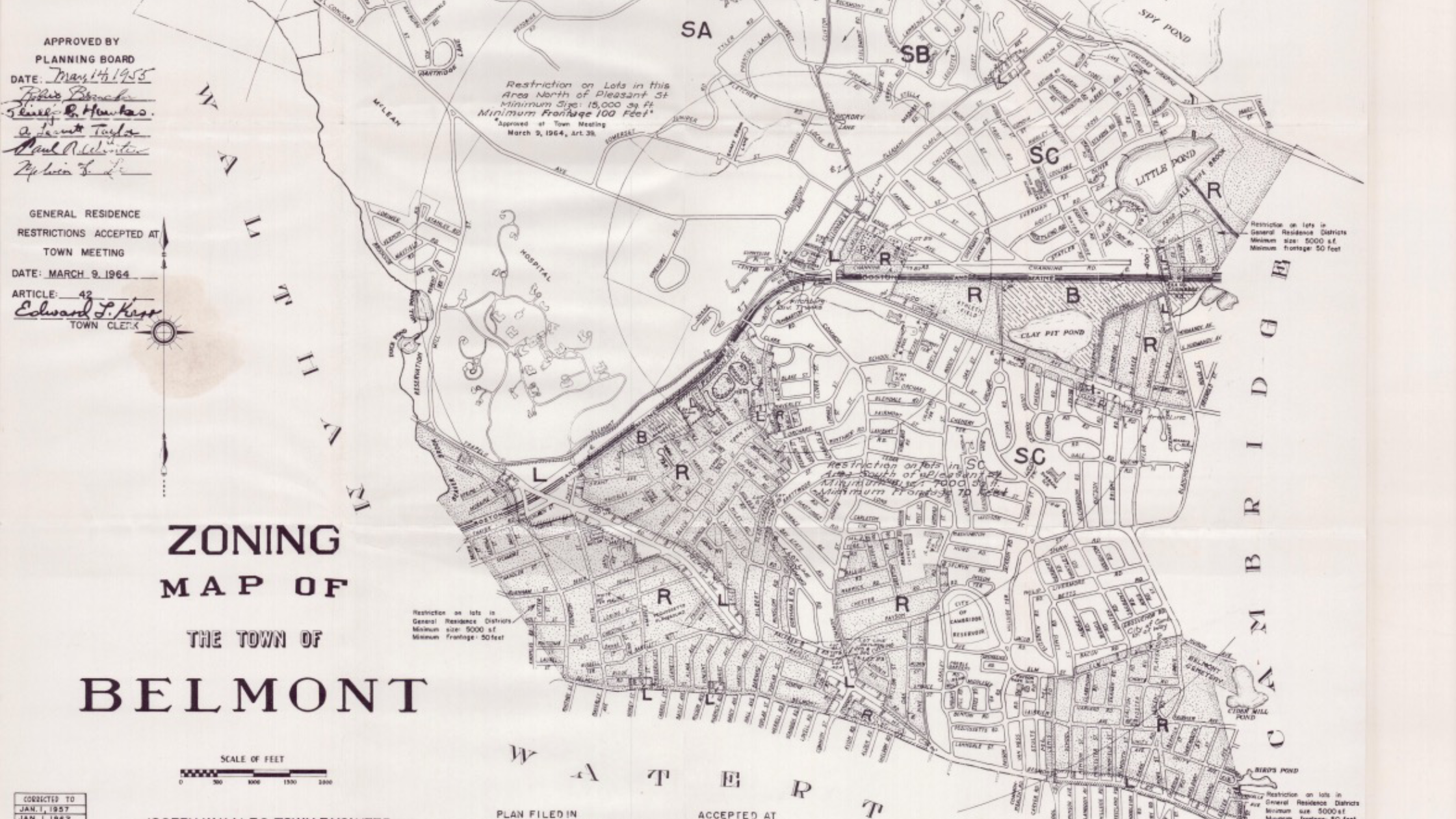
Belmont has four single residence districts. Here is what each requires today, and where the floor would land.
| District | Lot size today | Frontage today | Under Question 7 |
|---|---|---|---|
| SR-A | 25,000 sq ft | 125 ft | 5,000 sq ft, 50 ft |
| SR-B | 12,000 sq ft | 90 ft | 5,000 sq ft, 50 ft |
| SR-C | 9,000 sq ft | 75 ft | 5,000 sq ft, 50 ft |
| SR-D | 25,000 sq ft | 125 ft | 5,000 sq ft, 50 ft |
| GR | 5,000 sq ft | 50 ft | No change |
In SR-A and SR-D, the required lot would shrink by 80 percent. That number alone makes the measure sound enormous in Belmont. Then you read the next page of the by-law.
Belmont's setbacks do most of the work
A setback is how far a house must sit from each property line. In SR-A and SR-D, Belmont requires 30 feet in front, 15 feet on each side, and 40 feet in back. Those rules survive Question 7, because the measure specifically leaves setbacks to the town.
Take a hypothetical lot, used here only to show the math: 5,000 square feet shaped 50 feet wide by 100 feet deep. Apply Belmont's SR-A setbacks and you have 20 feet of width and 30 feet of depth left. That is a 600 square foot footprint.
| District | Buildable width | Buildable depth | Footprint limit |
|---|---|---|---|
| SR-A and SR-D | 20 ft | 30 ft | 600 sq ft |
| SR-B | 30 ft | 45 ft | 1,250 sq ft |
| SR-C | 30 ft | 45 ft | 1,250 sq ft |
In SR-B and SR-C, the 25 percent lot coverage cap binds before the setbacks do. Either way, a small lot in Belmont produces a small house, unless the town also adjusts its size rules.
Belmont wrote those setbacks for 25,000 square foot lots. Nobody has decided yet whether they still count as reasonable on a lot a fifth that size. The state housing office would sort that out after the fact. Until it does, anyone telling you exactly how this plays out in Belmont is guessing.
What would it change in Watertown?
Less, and that is worth knowing. Watertown was mostly built before modern zoning, on small lots. Its by-law still reflects that.
| District | Lot size today | Frontage today | Under Question 7 |
|---|---|---|---|
| S-6 single family | 6,000 sq ft | 65 ft | 5,000 sq ft, 50 ft |
| S-10 single family | 10,000 sq ft | 80 ft | 5,000 sq ft, 50 ft |
| T two family | 5,000 sq ft | 50 ft | No change |
| R.75 and R1.2 | 5,000 sq ft | 50 ft | No change |
| CR cluster | 40,000 sq ft | 100 ft | 5,000 sq ft, 50 ft |
S-6 would move by 1,000 square feet. S-10 would move by half. Three of Watertown's residential districts already sit at the proposed floor and would not change at all.
Question 7 would be a modest adjustment in Watertown and a significant one in Belmont. Two towns that share a border, one law, two very different results. Keep that in mind when you hear someone describe what this does to "the suburbs."
How would this affect people who already live here?
Zoning changes reach residents through a handful of practical channels.
If you own a large lot
Lot minimums are what stop a big parcel from being split. Lower the minimum and some lots can be split that cannot be split today. That could raise what your land is worth. It could also mean a new house going up beside one that has had open space next to it for decades.
Splitting a lot is never automatic. Frontage, setbacks, lot shape, wetlands, easements, and sewer lines all decide it. Anyone who says your yard is worth a building lot without measuring it is guessing.
If you are trying to buy here
More legal lots eventually means more homes. Smaller homes tend to cost less than big ones. The effect is real but slow. It shows up over years, not in one spring market.
For context on what entry looks like today: across the trailing 90 days ending September 13, 2026, the median Belmont single-family sale was $1,600,000 and the median Watertown condominium sale was $696,500. Those are the two ends of the local ladder, and the gap between them is exactly the space a smaller new home would occupy. Source: MLSPIN.
If you are thinking about selling
Nothing here changes your value this year. What it could change is who your buyer is. On a big parcel in a town with high minimums, a builder joins the pool of buyers. More bidders is usually good for a seller. It is also the outcome neighbors tend to object to.
If you are a neighbor
Denser blocks mean more cars and more strain on water and sewer. They mean less open space between houses and a different look to the street over time. This is what people mean by neighborhood character. It is fair to weigh.
Why do supporters say this is necessary?
The campaign for the measure is Legalize Starter Homes. Its argument is simple. Large lot minimums spread each house across more land. That makes homes scarce and costly, and it pushes builders toward fewer, bigger houses to earn back the land cost.
The data behind that argument is not subtle. The National Zoning Atlas published a statewide analysis in 2026 with these findings:
- 99 percent of land where single-family homes are allowed carries a minimum lot size rule
- More than half of that land requires at least 40,000 square feet, close to an acre
- 24 percent requires at least 80,000 square feet, close to two acres
- Single-family homes are allowed on 96 percent of residential land; buildings with four or more units, on 3.5 percent
Supporters also point to production. Massachusetts ranked 45th among states in new housing built per capita in 2024 and 47th in 2025. The state's own housing plan, "A Home for Everyone," calls for 222,000 additional homes between 2025 and 2035. That works out to about 22,200 a year. The administration reported more than 34,500 homes added in 2025, which is ahead of that pace, though production is not spread evenly across communities.
The measure is endorsed by the Greater Boston Real Estate Board, the Massachusetts Association of REALTORS®, Abundant Housing Massachusetts, the Home Builders and Remodelers Association of Massachusetts, the League of Women Voters of Massachusetts, and the editorial board of The New York Times.
Why do opponents say this is the wrong approach?
The Massachusetts Municipal Association testified against the measure. Its case rests on three points.
Local control. The MMA's executive director, Adam Chapdelaine, told the legislature that "zoning decisions are inherently local" and that a statewide rule removes the role residents and local officials play in shaping their own communities.
Capacity is not the same as access. The measure requires that a lot have access to public sewer and water. The MMA points out that many town systems are already at or near their limits. A pipe in the street does not prove there is room in it.
No affordability requirement. Nothing in the measure requires that the resulting homes be affordable or sold below market. Smaller homes are usually cheaper than larger ones, but the text guarantees nothing about price.
The MMA also argues the state already has a better tool in the Starter Home Zoning Districts program under Chapter 40Y, which encourages small-lot zoning through local adoption and incentives rather than a statewide mandate.
What does a yes vote mean, and what does a no vote mean?
Here is the trade in plain terms.
A YES vote means
- Towns must allow a single-family home on any residential lot of 5,000 square feet with 50 feet of frontage and public sewer and water
- More parcels become eligible to be divided and built on, especially in towns with large minimums like Belmont
- Over time, more homes and more small homes, which tends to ease price pressure slowly
- Denser blocks in places that are currently spread out, with the traffic, infrastructure demand, and change in streetscape that follows
- One statewide rule replaces a local decision, and towns lose the ability to set their own lot minimum above the floor
A NO vote means
- Nothing changes. Every city and town keeps setting its own minimum lot size
- Belmont keeps requiring 25,000 square feet in SR-A and SR-D, and 9,000 to 12,000 in SR-B and SR-C
- Neighborhoods stay at their current density, and decisions about growth stay at Town Meeting and City Council
- This particular effort to add housing supply ends, and the state pursues its 222,000-home target through other means
- The pressure that produced this ballot question does not go away, and something else will likely follow
Polling suggests the measure is favored. A UMass Poll conducted August 5 to 12, 2026 found 59 percent in support, 21 percent opposed, and 14 percent undecided.
Where does this fit with the state's housing law?
Question 7 did not appear from nowhere. Governor Healey signed the Affordable Homes Act in August 2024, authorizing $5.16 billion and close to 50 policy changes, including allowing accessory dwelling units by right in single-family districts statewide. The MBTA Communities law, passed in 2021, requires 177 communities to zone for multi-family housing near transit.
Question 7 addresses something those laws left alone. The MBTA Communities law is about apartments near transit. The ADU law is about a second unit on an existing lot. Question 7 is about the lot itself, and about detached single-family homes, which is the form most of Belmont and Watertown is built in.
What should you do before November 3?
Find out what district you are in. Belmont's zoning map and Watertown's are both public. Your district determines whether any of this touches you at all. If you are in Belmont's GR district or Watertown's T, R.75, or R1.2 districts, the answer is that it does not change your lot minimum.
Measure your frontage, not just your acreage. The 50-foot frontage requirement disqualifies plenty of large parcels. A deep lot on a narrow street may not qualify no matter how big it is.
Do not price a purchase on what might happen. If you are buying, buy the house and the neighborhood as they exist today. Zoning changes take years to show up in what gets built.
Ask before you assume. If you own land in Belmont or Watertown and you are wondering what this could mean for it, that is a measurable question and we are glad to walk the parcel with you. Bring the plot plan. We will look at frontage, setbacks, shape, and utilities and tell you what we see, including when the answer is that nothing changes.
Have a question about your property?
Whether you are voting, buying, selling, or just trying to understand what happens next on your street, a conversation costs nothing.
Schedule a callDisclosure and sources
My professional associations support this measure and have funded the campaign. Through September 4, 2026, supporters had raised $1,717,536. The Greater Boston Real Estate Board contributed $350,000, the Massachusetts Association of REALTORS® PAC contributed $350,000, and the association itself contributed another $150,000. That is roughly half of all money raised. No committee registered in opposition and no opposing money was reported. You should know that before you weigh anything I have written.
- Initiative Petition for a Law to Allow Single-Family Homes on Small Lots in Areas with Adequate Infrastructure, filed text and official ballot summary
- Town of Belmont Zoning By-Law, Sections 4.2.1 and 4.2.2, as amended through March 3, 2025
- City of Watertown Zoning Ordinance, Article V, Section 5.04
- National Zoning Atlas, Zoning Report: Massachusetts, 2026
- Executive Office of Housing and Livable Communities, "A Home for Everyone: A Comprehensive Housing Plan for Massachusetts"
- Massachusetts Municipal Association testimony, March 16, 2026 hearing
- UMass Poll, August 5 to 12, 2026
- Massachusetts Office of Campaign and Political Finance, reports through September 4, 2026
- MLSPIN, closed sales June 16 to September 13, 2026
This article explains a ballot question and does not tell anyone how to vote. It is not legal advice. Zoning questions about a specific parcel should go to your town's zoning office or a Massachusetts real estate attorney.