Market Interpretation
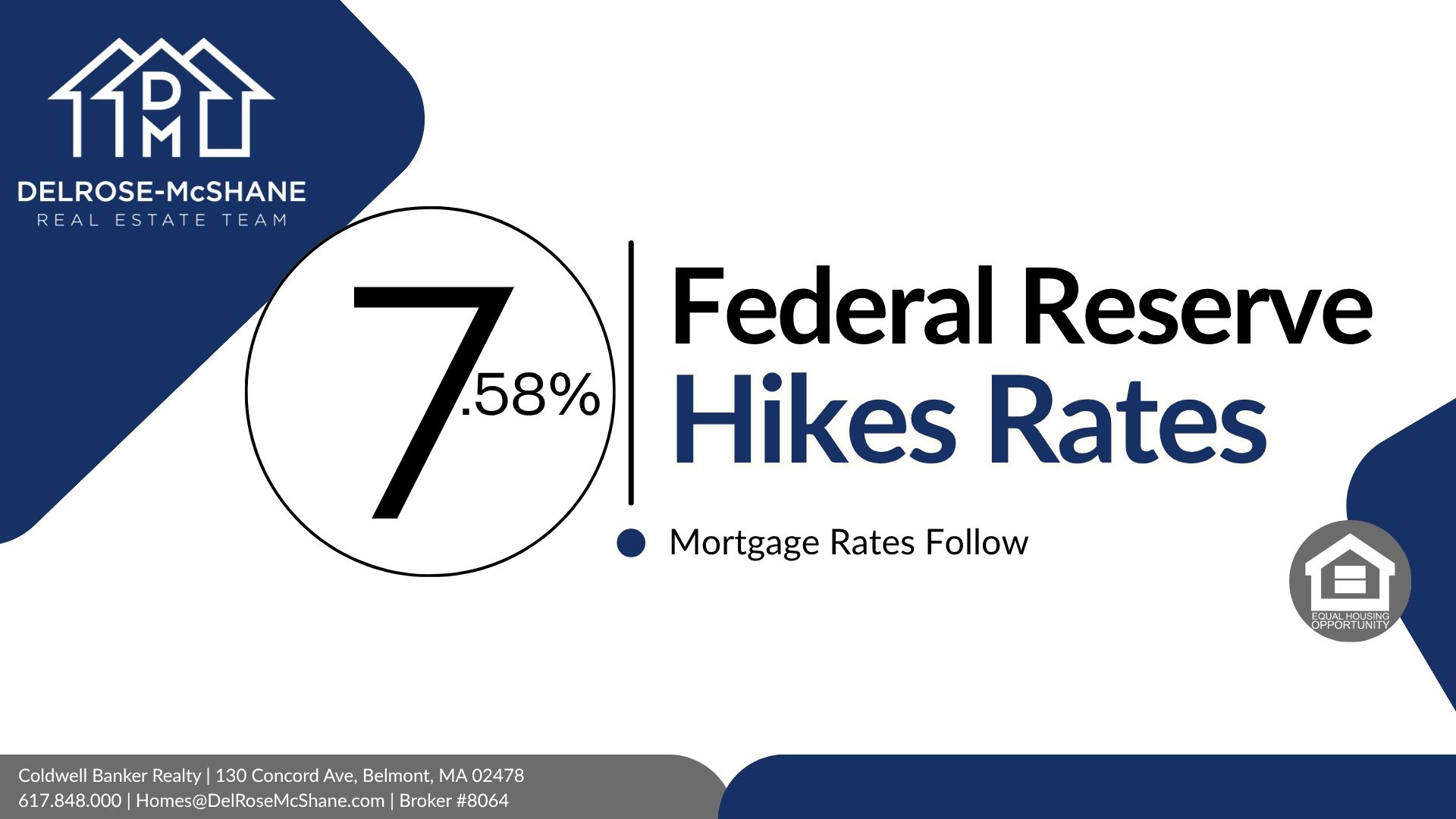
Federal Reserve Hikes Rates. Mortgage Rates Follow.
The Federal Reserve raised its benchmark rate on September 16, the first increase since 2023. Mortgage rates were already rising before the vote and kept rising after it. Mortgage News Daily's 30-year fixed index reached 7.58%, the highest since November 2023, after six straight weeks of increases. On a median Watertown home, that works out to about $600 a month more than a buyer would have paid a year ago.
Watch: What the Fed's hike means for buyers and sellers in Belmont and Watertown.
Earlier this month I wrote about the cost of waiting, and the math in that piece was built on a 6.65% rate. Three weeks later, 6.65% looks like a good deal.
This one needs a little explaining, because the headline most people saw was "Fed raises rates," and the natural assumption is that the Fed raised mortgage rates. It did not, at least not directly. What it did was tell the market something, and the market reacted.
What actually happened?
On September 16 the Federal Open Market Committee voted 12 to 0 to raise the federal funds target by a quarter point, to a range of 3.75% to 4.00%. It was the first increase since 2023. The statement pointed to inflation that has not come down the way the Fed wanted, with energy prices doing a lot of the pushing.
Mortgage rates had been climbing for weeks before the meeting. The Mortgage Bankers Association now has six consecutive weekly increases on the books, and Mortgage News Daily's index hit 7.58% at the end of September. Rates did not jump because of the vote. They kept going because of what the vote signaled.
Why doesn't the Fed set my mortgage rate?
The federal funds rate is what banks charge each other to borrow overnight. Your 30-year mortgage is priced off the bond market, and bond investors care less about where the Fed is today than about where they think it is headed and what inflation will look like over the life of a loan.
A rate hike can push mortgages either way. If investors believe the Fed is going to win the fight with inflation, long-term rates can actually settle. This time the market read the hike as a sign that inflation is stickier than anyone hoped, and that more increases could follow. That read is what moved your rate.
What does it cost?
A year ago Freddie Mac had the 30-year fixed at 6.30%. Put the median Watertown home, about $884,000 over the last three months according to Redfin, against both rates with 20% down.
| Rate | Monthly payment |
|---|---|
| 6.30% (a year ago) | about $4,377 |
| 7.58% (today) | about $4,984 |
| Difference | about $600 a month, a little over $7,000 a year |
That is for exactly the same house. I find it more useful to flip it around and ask what the same payment buys. The $4,377 a month that bought an $884,000 home a year ago supports a purchase of about $776,000 today. Nothing about the house changed. The buyer's budget did.
Belmont is a different conversation. The median single-family sale there was $1.55 million over the last 90 days, so most purchases need a jumbo loan, and jumbo pricing does not track the conforming averages. The Mortgage Research Center had the 30-year jumbo at 7.60% this week, which puts principal and interest on that median with 20% down at about $8,750 a month. The spread between lenders on jumbo loans can be meaningful, so shop it.
If you want the town by town picture, my September market update breaks down inventory and pricing across Belmont, Watertown, Waltham and Arlington.
Should you wait for rates to come down?
Nobody knows where rates go from here, including me. The Fed meets again October 28, and futures markets are pricing in some chance of another increase before the end of the year. That is a forecast, not a fact, and rate forecasts have been wrong plenty of times.
What I said in September still holds. Waiting is a position, and positions have a price. If rates fall meaningfully over the next year and prices stay flat, waiting will have been the right call, and I will be the first to say so. If they do not, you will be shopping for a smaller house than you could buy today, and there is a good chance you will be doing it in the spring against more buyers with less time to decide.
There is always another house. I believe that. It just will not always be the one you wanted, and it will not always be at this price.
What can you still control?
The rate itself is out of your hands. A few things are not.
Your rate lock. With rates moving day to day, talk to your lender about lock periods and float-down options before you write an offer, not after you have an accepted one.
A buydown. Paying points up front lowers your rate for the life of the loan, and a seller can pay those points as a concession. On some deals a seller-paid buydown does more for a buyer's monthly payment than a price reduction of the same dollar amount.
The negotiation. Active listings across Greater Boston are up about 15% from a year ago. The median time on market in Belmont has gone from 15 days to 19, and in Watertown from 20 to 22. That is not a buyer's market, but it is more room on price and terms than buyers had in the spring.
What if you are selling?
Every buyer walking through your house has already run the numbers above. A higher payment makes buyers more careful, not less interested, and careful buyers are very good at spotting a house that is still priced for last spring.
In a market like this, the homes priced correctly the day they go live are the ones that sell well. The ones that start high tend to sit, and when they do sell, it is usually for less than they would have brought at the right number on day one. If the buyer's payment is the real obstacle, a credit toward a rate buydown is often a better tool than a price cut, and it is worth talking through before you list.
You only know the market you are in. This is the one we are in, and it is still very workable if you plan around it.
Let's run your numbers
If you are buying or selling this fall, I will sit down with you and work through your actual payment, your timing and your options, rather than the averages in this article.
Schedule a call Find homes with MikeSources
- Federal Reserve, FOMC statement, September 16, 2026
- Mortgage News Daily, daily 30-year fixed rate index, most recent reading as of September 30, 2026
- Mortgage Bankers Association, weekly mortgage applications survey, reported September 30, 2026
- Freddie Mac, Primary Mortgage Market Survey, year-ago 30-year fixed average
- Mortgage Research Center via Forbes Advisor, 30-year jumbo average, September 30, 2026
- MLSPIN, Belmont single-family closed sales, trailing 90 days ending September 28, 2026
- Redfin, Belmont and Watertown housing market data, three months ending August 2026
Payment figures are estimates of principal and interest only and do not include taxes, insurance, or fees. Mortgage News Daily's daily index usually runs a little higher than Freddie Mac's weekly average. This is not financial advice. Talk to a licensed lender about your own rate and terms.